Follow The Story from the Beginning

Follow the Story from the Beginning
This story was partly written and partly recorded by The Captain. It's told in Chapters. To read the story in the order it's told, start with the first Chapter by using the Archive list in the right column. When you catch up, you can sign up to get a notice each time a new chapter is posted.

Sunday, November 14, 2010

Chapter 26 - Escaping the War

Chapter 26 – Escaping the War

To relieve the alternating stress and boredom, we were given furlough passes every two to three weeks, usually for two days. The closest train station was in Braintree about 5 miles away. If you wanted to head for London, which was about 45 miles southwest by train, you needed a bike get to the station. You could usually find one somewhere on the base. There was even a guy on base who repaired bikes and he always had a couple ready to go if you couldn’t borrow one from another GI.

If you rode a bike into the station, the next person who arrived at the station might borrow it to get home. You always had to worry about finding a bike there when you got back. It wasn’t much fun to get back from leave and have to walk back to the base. There wasn’t much hitch hiking in those days, people just didn’t have cars. Occasionally you could bum a ride from one of the businesses that had a “lorry” (truck) but you might have to help him make a delivery or two.

People in the neighboring villages were pretty friendly about sharing their bikes. No one ever locked their bike but they did have their names on them. We’d try to avoid taking the bikes with names on them whenever possible.  Every once in awhile the train station manager would send a truck out to the base to collect the bikes that belonged to the villagers.

It was safe to go into London now that the blitz was over. There was always something to do there during the day – and if you could find a place in the blackout - at night.  The German attacks to demoralize London, “the Blitz” had started in September 1940 and continued until May of 1941 when Hitler needed his Luftwaffe to invade Russia. However, London was still under a “blackout” three years later. There were absolutely no lights allowed on outside at night. All windows had to have blackout curtains blocking any light. So, you liked to know where you were when it got dark. It was best to plan to be inside at one of the GI clubs where there was usually a dance, music, food and lot of people. 

There were more than a dozen Red Cross Clubs in London some of them were for Officers only. Sooner or later we checked them all out and sometimes we even stayed in hotels just to get away from other soldiers for a day. Mostly we headed for the biggest and best club, which welcomed both officers and enlisted men, The Rainbow Corner. It was located in the West End, a few blocks from Piccadilly Circus – where all the theaters and shops were – so there was always something to do.


Sheet Music of a song about the Rainbow Corner

You could get a room at the Rainbow Corner for about 50 cents and they had real sheets. They had just about anything else you needed from a laundry to a barbershop. You could take a hot shower or a bath. The Red Cross was famous for supplying doughnuts and coffee to servicemen (even if they had to deliver them by mobile units) and you could usually get a sandwich and piece of cake or a bottle of Coca Cola at the donut canteen downstairs. They also served hot meals there, usually fish or rabbit and vegetables or something with beans. London had been under rationing so long you took whatever food you could get. There was usually a live band and dancing at least 3 nights a week and there were plenty of records for dancing if there was no live music. There were movies, magazines, newspapers, drinks, cigarettes and you could play cards, ping pong, games or do jigsaw puzzels. There were lots of friendly ladies that volunteered at the club and they were always ready to dance or play table games, write letters for guys that needed help with them, or sew something for you. There were even counselors for guys that were messed up.

Time passed too quickly when you were off base on a pass and it seemed like you’d just left when it was time to go back. 

Wednesday, November 10, 2010

VETERANS DAY 2010

Today we take time to remember, honor and thank all the brave veterans of all the wars who fought to protect our freedoms.

On this 11th day of the 11th month at 11:11 stop for just a minute and imagine you can hear the 21 gun salute and the playing of TAPS to honor and keep the faith with all our soldiers.

We can never thank them enough.

Saturday, November 6, 2010

Chapter 25 - Off We Go Into the Wild Blue Yonder!


 We flew our first mission on March 5, 1944. We were told never to talk about our missions, everything was very secret. We never knew where we’d be going until we went to our briefing sessions before each mission and got our assignments. Although, mostly we knew we’d be going over Holland, Belgium, France (all occupied by Germans at that time) or to Germany itself. The B-26s were assigned both primary and secondary targets. Our mission was to get in, drop the bombs and get out.  

The targets included marshalling yards, roads, bridges, ammunition dumps, power stations and shipyards. We flew in formation in what they called boxes. The mission leader flew in the middle of the first row with #2 plane on his right and #3 plane on his left.  Directly behind the leader was #4 with #6 on his right side and #5 on his left side.  

Usually the leader was the only plane with what they called the Nordin Bomb Site. That was a special navigation instrument for locating your exact target. They weren’t very plentiful at the time and every plane in the formation was to watch the leader – when he dropped his bombs you dropped yours. If no one had a Nordin, everything was done by sight navigation.

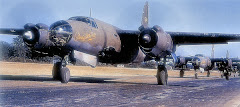
B-26 In Flight                                


B-26s in Formation, Flak Exploding

We flew seven missions in March and twelve missions in April. On non-mission days we were doing a lot of training now that we understood what combat was. The crew always wore parachutes in case we were hit and had to abandon the ship. Medium level (altitude) bombing meant we were flying in the range of 8,000 to 10,000 ft. At 10,000 feet you had to wear your oxygen mask. It got pretty cold at those altitudes. We were dressed in uniforms with electric wires that we could plug in to get warm. 

The biggest hazard was the anti-aircraft (ack-ack) guns being shot at us from the ground. We were doing daylight bombing and you could see it exploding all around you plus it created wind bumps every time it was close. Eventually there were diversionary tactics that we took at higher altitudes. The whole formation had to follow the same orders. Trying to divert to avoid ack-ack on our own would put the formation at risk of colliding with each other so there was no dodging bursts on your own. It made for raw nerves most of the time. The second hazard was actual attack by the Luftwaffe. That’s when our fighter planes (mostly RAF Spitfires) were supposed to protect us. So far we’d managed to escape both the ack-ack and the attacks with very little damage. We were also doing a fairly good job of hitting our targets.

One of our missions was called a “Grudge Raid.” You remember that the original B-26 low-level flying over Holland targets had been a disaster. They were flying right down on treetop level when they flew those first missions. One of the targets had been a power station, the other a U-boat base – both in the Netherlands. It was just across the border from France. Holland was occupied by Germany but the people of Holland were our friends. On that mission, the Command had decided to warn the people of Holland they were coming, so they broadcast the raid on the radio. Of course the Germans heard it too and were prepared for them. Nazis were even up in the tops of the Church steeples shooting at them. The Germans managed to knock out all but one or two of the B-26s and only a few men got back. I think about 60 were lost or missing. I heard that 24 ended up in German POW camps.

The Grudge Raid was targeting the same installations but this time we would be flying at 12,000 feet. That was our best altitude because by then they had found out it took the Germans seventeen seconds to track us and get a shell up to us at that altitude. Therefore, we never flew in a straight line for more than 15 seconds. Many times we could see big black clouds of exploding shells right where we would have been had we flown straight for another two seconds. I called that cutting it close. There were 300 B-26s on this Grudge Raid on the U-Boat installation.

The first week in May the 322nd threw quite a celebration when one of the B-26 planes, named the “Mild and Bitter” became the first bomber of the Allies to complete100 missions. Not only that, it had never lost an engine or sustained major damage and no crewman had ever been hurt on those missions. We weren’t assigned the same plane every time we flew, so over 166 men on the base had flown a mission on the Mild and Bitter at one time or other. It was the pride of the 9th Army and it was a big celebration. By the end of July there were a total of 10 B-26s in the 322nd that made it to 100 missions, a real tribute to their dependability. (After the disastrous start in Holland in ‘43 the B-26s ended the war with under 1% combat losses.)

About that time Command decided that we would do some night time training in formation flying. Our crew Captain, Lt. Davison decided that it was too dangerous to fly formation at night. He went to the Squadron Commander and told him he wouldn’t do it. The Commanding Officer called me in and told me what Davison said. He asked me what I thought about night flying. I said I thought it couldn’t be much more dangerous than flying over enemy territory in broad daylight and having anti-aircraft shells exploding all around us. He demoted Lt. Davison to co-pilot and made me crew commander. He assigned the same crew to me and gave me a new co-pilot by the name of Jimmie Deloach.  Lt. Davison would be flying co-pilot with the C.O. from then on. It turned out we practiced some night flying but we never did actually fly any night time missions while I was there.

We flew another twelve missions in May. Most of them were on railroad yards and fuel dumps near cities along the coast of France that were occupied by the Germans. Our missions were not much over four hours long because even though we carried about the same bomb load as the B-17s (which had 4 engines to our 2) we only had about four and a half or five hours of fuel. Even though flight time averaged about 4 hours, there was about 3 1/2 hours prep time before leaving and some check out time after so there was a lot of tension and adrenaline flowing on mission days and it was always a relief to get back.

Thursday, October 28, 2010

Chapter 24 - We Finally Join the War!


 Finally, on March 3, 1944 we got our orders to go to England. We were transferred to the Ninth Army and assigned to the 450th Squadron of the 322nd Bomb Group. The 322nd was the B-26 Bomb Group that had the disasters in Holland when doing the low level bombing back in the summer of ’43. However, it had not been the 450th Squadron and we were now Medium level bombers.

                     Andrews Air Field, (Great Saling) Britain 1944

We were sent to Andrews Field which was located near Braintree, England in an area called Great Saling. It was called Station AAF-48. It was about 40 miles northeast of London in the County of Essex. Not too far away in a place called Bury St. Edmonds, there was an RAF field. (Royal Air Force) There were also a number of RAF Fighter Squadrons stationed at Andrews as support Fighters. The 322nd had been based at Bury St. Edmonds when they flew the low level attacks on Holland but had been transferred to Andrews in June of ‘43. Also, in December of ‘43, about four months before we got there, Andrews had been attacked by the Luftwaffe (Germans) but there was no apparent damage to be seen by the time we got there.

        
Andrews was what they called a Class A airfield and was built by Americans about 18 months before we got there. Class A meant there were 3 runways, roughly located in a triangle shape. The main runway was 6,300 feet long, 300’ longer than usual. The other two runways were shorter. Andrews was the only British field named after an American: General Frank Maxwell Andrews, who had been killed in an airplane crash. Before that it was called Great Saling.

This base was the squadron headquarters and was a full operating base, not a training base. In addition to the headquarters, there was an iron hut building for mission briefings and debriefings, a mess hall, hospital, a chapel, store, supply warehouses, a motor pool and living quarters. The officer’s living quarters were on the east side and were mostly the corrugated iron huts with brick ends that had a door and 2 windows covered with black out curtains. The floors were concrete and there was a small stove in the middle for heat. They were cold, damp and musty. There was a bath hut with tubs, showers and hot water but little heat. Since our quarters were about a mile away from the runways we would mostly march from place to place. Bombs and ammunition were stored outside the perimeter in what they called munition “dumps.” They were a combination of concrete and dirt mounds to protect the ammunition from attack or crash landings. The fuel dump was on the north side of the base. There was a tower, two hangers and several maintenance shops for the constant repair of the planes coming back from combat. I think there were a couple thousand men on the base in one capacity or another.

On Mission days we were usually up at 5am and went to the mess hall for breakfast. Later, an Army truck would pick us up at quarters and deliver us to the briefing hut. Everyone was to be in the hut by a certain time and sometimes bring your equipment, other times get it afterward. That would include your full flight suit, flack jacket, warm helmet and hard helmet, gloves, parachute and combat gear. You didn’t want to put that on until you were ready to fly.

There was a stage at the front of the building (opposite the end with the door) and rows of chairs with an aisle down the middle. Behind the stage on the wall there was a map that was usually covered until the briefing started. Briefings started when the C.O. (Commanding Officer) walked into the building and someone yelled Attention! He would put us at ease and the Operations Officer would take over, reveal the map and give us the skivvy on the mission’s goals. It might be taking out an ammo dump, hitting a marshalling yard or whatever the target was. They would give us information about the target and tell us where we might encounter heavy anti-aircraft attack concentrations. We were given a lot of details, including things like the ships that we might pass over as we crossed the channel.

Crew pilots were given a Mission sheet which told them things like which plane their crew would be assigned to (by serial number) what place they’d be in the formation, what number they’d be in line for take off and what time they should start their taxi and take off. It told the Capt if there were other Groups on the Mission, what color the leader’s flares were, what the radio frequencies would be. They were given altitudes, wind speeds, call signs, locations for emergency landings and the list of the Fighters supporting us. There were code names and colors of the day which were only good for certain hours and prevented us from getting fake radio interference by the Germans. There were detailed instructions on how to communicate on the Mission day.

When I made Captain and got my first Mission sheet I was surprised to see the "Standard Operating Procedure to follow when landing on the Continent" clearly written out at the bottom. That would be equivalent to a crash landing – or at least a crippled emergency landing. The SOP said: 1. Whenever possible, land at a field at which 8th AF Service Command Center facilities are located. 2. Have radio operator contact base giving necessary information. Pilot can contact ground station on VHF. 3. After landing, pilot will (s) arrange for medial assistance, if necessary, (b) fill out “Forced Landing Card” from rear of pilot’s or co-pilot’s seat, (c) safeguard all secret and confidential items on ship, (d) contact nearest 8th AF Service Command Service Center representative if one isn’t on the field and (e) contact home base. (Use VHF or W/T in the air or on the ground.) 4. Crew members will be responsible for individual flying equipment.

After the main briefing, the Intelligence Officer filled us in and after that the weather reports. Then we’d set our watches so that everyone had the exact same time down to the second, so that we could follow the take off instructions exactly. Precision was extremely important. When the briefing was done and the C.O. marched out, we’d gather our gear or head back to get it and climb aboard the Army trucks that would take us all to our planes. Usually Officers went in one truck and enlisted men in another since we lived in separate huts.

Friday, October 22, 2010

Chapter 23 - Northern Ireland


 Chapter 23 -  Northern Ireland

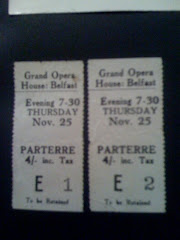
Our assignment at Langford Lodge (the name of a Royal Air Force Base, not actually what we call a lodge) was what they called a replacement pool for the American groups in England. We didn’t do much flying or even pull much duty at all. We had a lot of time on our hands. We bought bicycles from the guys that were moving out to new assignments and rode all over the Irish countryside. We went into Belfast any chance we got. One night in late November Lt. Davison and I even went to the Grand Opera House in Belfast. It was quite a dramatic event with costumes and wonderful music.


One thing that broke the monotony was kind of funny. We all looked forward to mail call and like everyone else I was always anxious to hear from my fiancé or my family. One day an envelope showed up – from the Man on The Street reporter in Jacksonville, FL! He hadn’t run my story in the paper but he’d sent the picture he took of me to the address at the Avon Park base and it had finally caught up with me! We all had a big laugh over that! There were some amazing things that the Army managed to do during the war.


On the whole, time dragged on so much that some of the crews volunteered to transfer and get checked out in B-17s just to get out of Ireland. One of my best friends, Jack Scarlett and his crew, did just that. However, I stayed with the B-26. Had I known we were going to be there for a total of six months or anticipated another event like the one I am going to tell next, I may have made a different decision.

One day our crew was assigned a training flight. All B-26s were being retrained in medium altitude bombing. Lt. Davison, the Captain, was interested in reading a book, so he told me to take the flight up with the flight engineer in the co-pilot’s seat. He sat in the bomb bay and read his book. Just as we took off and were leaving the ground both props went into flat pitch! It was happening again! Only this time it was both engines at once and I was in the left seat! The engineer and I both pushed the manual overrides while I tried to keep the plane in the air. You had to be pretty strong to control these planes and again we were going down fast!  At the same time I was trying to slow down our descent I doing everything I could to keep us going in a straight direction and restart the engines. Just as we managed to get the props going again and start gaining some altitude we broke through a power line that was located just past the runway area!

The Tower said all they could see was a big flash and they thought we blew up. Somehow it didn’t spark the fuel or electrocute any of us and when the flash cleared they saw the “phoenix” rising into the blue. I made a large turn and got back in line for landing. It was good to have our feet on the ground! When we examined the plane we found a large hole burned into one of the props where we’d hit the power line. The locals weren’t too fond of us after that. I think it took a couple days for them to get their power back.

Sunday, October 3, 2010

Chapter 22 – Assignment: Northern Ireland – Replacement Depot

After a week of getting to know each other’s families and getting to know each other better, it was time for me to get on a train back to camp. I sure hated to leave my family and my fiancé. When we got to Jacksonville, FL I had to change trains to get to the base. I had a couple hours to walk around Jacksonville and I was looking for a phone to call Lorraine. Back then almost every newspaper had what they called a “Man on the Street.”  He was a photographer who went around taking pictures of people all day and asking them a question. They picked a few to print in the next day’s newspaper. They would take your name and address and mail you a copy of the picture they took even if they didn’t use yours. Sure enough the Jacksonville Man on the Street snapped one of me. I gave him my address at Avon Park because I had no idea where I’d be the next week.

On August 25, 1943 we received our orders to proceed to Camp Kilmer, New Jersey for embarkation. We were put on a troop transport train that took a couple days to get to Brooklyn, New York. We were transferred to Camp Kilmer where, surprise!, we were to prepare to “set sail” for England. We’d trained for almost a year as pilots, engineers, navigators and bombardiers. We thought we would be flying to Europe! We were going to be the first group that wasn’t flying their own planes over. Apparently they had more planes than crews overseas. It would be another great experience: crossing the Atlantic by ship. Instead of getting into action in a couple days it was going to be a long trip.

Camp Kilmer seemed to be in mass confusion. Instead of leaving the next day, it was four days of waiting before we left. Luckily one night the officers got passes to go into New York City. Three of us headed for The Hurricane Club in Times Square (49th & Broadway). The Hurricane was known for jazz and was the home of Duke Ellington at the time. This farm boy was living the high life. Once again, a photographer came along and took our pictures – for the princely sum of $1! This time I told the guy to send it to Lorraine.

After four days of hanging around Kilmer we were finally put on a train for a short trip to the Harbor where we boarded our ship – which turned out to be a converted cattle boat!  We were part of a huge convoy of ships and escorts. About one day out of port our “ship” had trouble with one of its boilers. We had to leave the convoy and return to Brooklyn for repairs. For two or three days they worked on the old tub and we had to stay on board the whole time. There were over 2,000 people on board. Once the trouble was repaired we joined another convoy heading to England. That was a relief. Our imaginations were running wild thinking we would be going it alone across the Atlantic, a sitting duck for German U-boats. Altogether we spent twenty-three days on the ship before we docked in Liverpool, England. From Liverpool we took a train to Prestwick AB, Scotland, then another boat to Belfast, Ireland. In Belfast our group boarded another train going to a base near the tip of Lock Ney (Lough Neagh), Langford Lodge.

    
          Tower at Langford Lodge 50 Years Later


Saturday, October 2, 2010

Chapter 21 - Rumors, Leave & An Engagement!


 The base was a busy, busy place. Crews were in all stages of training and transitioning to leave the states. We were waiting on pins and needles for our assignments. We were in the 280th Bomb Squadron, part of the Mighty 8th Army Air Force which was covering the European Theater. We knew there were bases in England, and Belgium – as well a support bases in Ireland, while the enemy had bases in occupied France, Belgium and Holland. Rumors abounded but we had no idea where we would end up. We already knew of the ill-fated disaster of the B-26 low level flying attacks on a power plant in Ijmiuden, Holland back in May (43). On May 14th “Eleven or twelve (sources differ) Marauders from the 322nd Bombardment Group took part in the attack, returning without loss.” The problem with that attack was that they didn’t hit any targets so it was rescheduled for May 17.  Eleven B-26s took off on the 17th. One plane had electrical problems and turned back. It was the only plane that survived. This time the enemy was prepared and the low level flying made them almost sitting ducks. The Mighty Eighth quit flying until July 16 when it was decided to put the B-26 back to work as a medium level bomber. Knowing all this made everyone nervous and apprehensive on one hand and anxious to get over there and do our part on the other hand - and then there was that guy with the red flags waving around in the back of my head.

In mid-August the Army decided that we were definitely shipping out, so they gave us a 10 day leave to day good-bye to our families. Some of the guys in our group hadn’t had a leave in over a year. I’d been extremely lucky. I’d had 3 leaves in as many months. Lorraine and I had been writing and even talked on the phone a few times since I came back from my tonsillitis furlough.  I couldn’t wait to get back to my brother’s place to see her. I grabbed my bag and caught the Dixie Flagler train North.

My mom and dad, back in Nebraska, decided they would come out to see me before I shipped out and they got on a train headed for Chicago. As soon as I got off the train in Terre Haute my brother, his wife and Lorraine picked me up and we headed for Chicago to meet the folks. We got there the night before they arrived. My brother’s wife, who was a beautician, was up on all the best places to stay in Chicago. We decided to pool our money and enjoy probably the (first and) last luxury we could expect to have in the next few years.

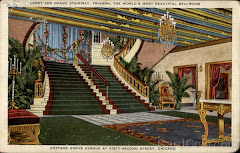
We checked into the Palmer House which was in the middle of what they called the Loop. I was told it was the most famous hotel in the city. I was sure it was actually a palace. All of us were in awe of the beautiful, huge lobby and its extravagant furnishings. The Palmer House was famous for its night club, the Empire Room, but my sister-in-law had her heart set on going to the Trianon Ballroom to dance to the music of Lawrence Welk. The Trianon was said to be the largest and most beautiful ballroom in the Country. It was so huge there was no problem getting in on short notice. I’d never seen or imagined anything like it. There must have been a thousand couples there that night but there was plenty of room to dance and you could hear the music from any part of the large dance floor.

I have to hand it to my sister-in-law, she had set the most romantic evening I could ever have imagined. “The Champagne Music Makers” played for hours and their music set the stage for romance. I’d given it a lot of thought and I new I was going to ask Lorraine to marry me but I hadn’t really planned to do it that night. It was a magical night and I knew there wouldn’t be another one like it in the near future. While we were dancing I asked Lorraine to be my wife and she accepted. I don’t think our feet touched the floor the rest of the evening! Later we told my brother and his wife and the four of us celebrated. The next day sanity was restored and by the time we met my folks at their train we had decided to wait until I came home before we got married. The six of us headed back to South Western Illinois for the rest of my leave.