Follow The Story from the Beginning

Follow the Story from the Beginning
This story was partly written and partly recorded by The Captain. It's told in Chapters. To read the story in the order it's told, start with the first Chapter by using the Archive list in the right column. When you catch up, you can sign up to get a notice each time a new chapter is posted.

Thursday, May 14, 2009

Chapter 12 Accessories Instill Pride

Now that we were in basic training at Enid we could relax a little. We were told that over 40% of our class had "washed out," but we'd made the grade. The Army was going to instill us with pride and convince us we were the best they had. They heaped praise on us for making it to this stage of training, calling us "the cream of the crop" and telling us we had the right to be proud. We kept marching to classes in cadence singing inspirational songs. We were told we were going to be the "best trained air-force in the world." The silver wings helped a lot.
Coveted Silver Wings of Cadets
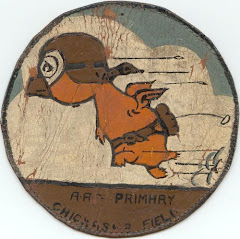
Cadet Insignia on Patch

Thursday, April 23, 2009

Chapter 12 The Magnificent Flying Machines

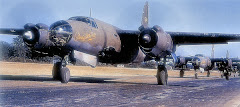
At Enid we got about 50 hours of training in the TB25 also known as the AT-24.  No more open cockpit, 2 seater planes for us, this was an exciting plane! They ones we had were 2 engine, dual controls that could hold a 3-5 man crew. The nose of the plane was what they called the "greenhouse" made of plexi-glass to give the bombardiers as good a view of their target as possible. Of course we didn't have any crew we were still learning to fly.

Thursday, April 2, 2009

Saturday, March 21, 2009

Chapter 12 Basic Flight Training, Enid OK

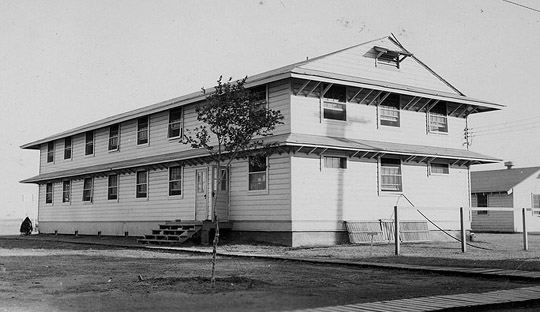
Enid Oklahoma was about 100 miles north of Chickasha. After a couple days leave we were loaded on a bus that traveled straight north on U.S. Highway 81 to Enid. We arrived about a year after it was first constructed. The barracks were two story frame buildings that looked like very large houses. There was the usual parade ground and of course hangers and runways. Built as a temporary base, the main feature was a huge water tower roughly in the center of the base.

One of the first things they did at Enid was issue rifles. We had to clean and assemble them and be able to take them apart and put them back together. For an old pheasant hunter like me it was second nature but many of the guys had never seen a gun before. Surprisingly, we weren’t taught to shoot the rifles, we just had to know how to assemble them and carry them in marches and parades.

They were very strict about us keeping orderly quarters. The term “white glove inspections” came from military inspections. The officer would put on a white glove and run his finger across every surface in the barracks. If any dust accumulated on the glove or discolored it, demerits were handed out. When you accumulated demerits over the maximum allowed you had to “walk them off” on the parade grounds on Saturdays. It was usually one hour of walking for each demerit over the limit.

Day to day classes at Enid continued, much like at the previous two bases, with the usual physical fitness drills, obstacle course, close order drills, marches, and lecture classes on military indoctrination, common courtesy, math, weather, navigation and specialty classes on airplane instruments, airplane recognition and airplane mechanics.

After about 70 hours of flying and daily classroom training, we were assigned to the TB25 airplane, also known as the AT-24. They were dual control, 2 engine bomber planes that flew with a 5 man crew. They had a top speed of over 300 miles per hour.

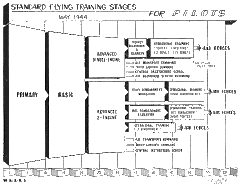
By the end of Basic they would decide who would be fighter pilots and who would be bomber pilots. Of course we all wanted to be fighter pilots, that’s why we practiced our aerial acrobatics every chance we got. They determined the assignments by instructor recommendations, tests they gave us, performance in class and what they needed most at the time.

Sunday, February 22, 2009

Chapter 11 Primary Flight Training Continues

In Chickasha we received our training at a civilian owned and operated flight school, The Wilson and Bonfils Flight School. Classes were also taught and flight checks given by a military staff.

Close order drill, calisthenics and obstacle courses continued in Primary school as did the classes in airplane recognition, meteorology, and ground school. The Army method of learning was memorization. We were expected to be able to memorize everything. It was a good discipline and in times of stress, it stood you well.
Our accommodations at W&B were known as the “Country Club” because everything was civilian in the mess hall from food to dishes and in the barracks from the beds and mattresses to the linens. Everything outside the mess hall and the barracks was strictly military.

In the afternoons our flight training continued. I was lucky to have done my solo a little earlier than most of the cadets. I was able to spend more time shooting landings and practicing the basics and acrobatics. When he rode with me after my solo, the instructor taught me forced landings. He’d cut the throttle and force me to find a place to land. Luckily there were a lot of fields in Oklahoma. Just about the time the wheels were going to touch the ground, he would take over and climb to a safe altitude, then hand it back and tell me to practice something else. Soon he’d cut the throttle again and I’d be forced to land again. Later, I spent a lot of time practicing these forced landings myself. Little did I know all that practice would eventually save my life and the life of 6 other crew members somewhere over France.

There were flight checks at the end of each phase of flying lessons. There was nothing the “checkers” liked better than washing out the unfit pilots. If you didn’t make the grade, or even if they just didn’t like you, you could be weeded out. You got two chances. If you didn’t pass the first test you got one more by a different checker. He knew it was your second of course, and if you failed his check you were reassigned to navigator or bombardier school. Luckily, I never had to take a second flight check.

Winter in Oklahoma was pretty cold and many days we woke to snow deep enough to entertain us guys by making snowmen or blow off some steam by having a few snowball fights. Mostly we had 10 short weeks to learn how to fly and between that and military drills and classes there wasn’t a lot of free time.

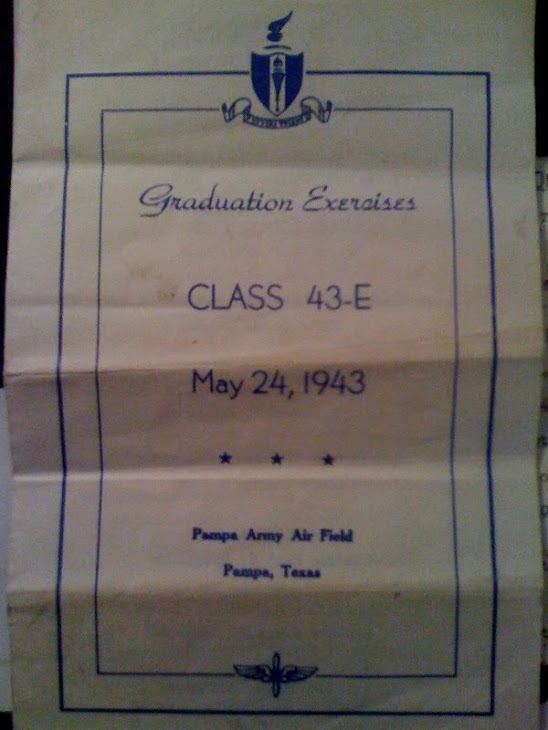
When our ten weeks was up Class 43E had a Graduation ceremony. Those that made it through were sent on to Basic Flight Training. Our class was going to Enid Army Flying School in Enid, Oklahoma

Tuesday, January 13, 2009

Chapter 10 Off We Go Into the Wild Blue Yonder!

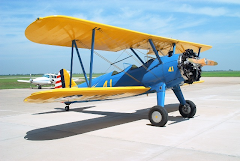
Beginning to Fly – Meet the Fairchild PT 19

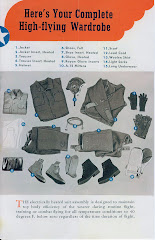
We learned to fly in the Fairchild PT 19 and the BC-1. The rugged little PT 19 was a one engine trainer aircraft. It had two open cockpits, the instructor sat behind you. It had plywood wings, fixed landing gear and flew at the phenomenal speed of about 130 mph! In truth, this was fairly slow for a light weight plane. The PT was also pretty stable, two positive factors for would-be pilots. Because of the open cockpit, the wind and colder temperatures the higher you flew, we were fitted out in two piece flying suits with fur collars, lined gloves, warm felt boots and leather helmets with goggles. (When we weren’t wearing the goggles, they were to be worn around our necks. Once we had completed our first solo flight we could wear them on our helmet.) Later, when we were overseas, our flying suits would have heated pants liners, heated jacket liners and heated gloves but for now we were so excited we didn’t notice the cold.

In addition to actual flying time every afternoon we were attending ground school and continuing our physical training during the first half of the day. We were also being thoroughly taught “military indoctrination” (the name of the course).

I was lucky to be assigned to a great instructor who stuck with me even though I was getting air sick just about every time I went up. I still remember my instructor’s name was William Dwyer. We were learning all the fundamentals: take offs, landings, forced landings, “s turns,” stalls, spins, loops etc. After about 24 hours of training with the instructor he told me to take my first “solo” flight which consisted of 3 or 4 take offs and landings. I was one of the first cadets in the class to do his solo and was quite proud to go back to the barracks wearing my goggles on my helmet.

The worst part of this training was when we started doing acrobatics. After training with the instructor for several days I would go up by myself and do several snap rolls, get sick, then go back and do it all over again. It took about forty hours of flying time before I got over the airsickness but it never bothered me again after that.

Monday, January 5, 2009

Chapter 9 Hallaleujah! Cadet School

I was first sent to an Army Air Corps base for recruits near Waco, TX. It was under construction at the time and after a few days, in March of 1942, we were sent to Kelly Field in San Antonio, TX for basic training. This lasted about six weeks. We did close order drill, took a lot of tests, did hours and hours of physical training and learned the usual Army routines. Weekends were for marching or parading.

We were billeted in tents while the base was under construction. They put us in alphabetical order and I became longtime friends with several men in my tent who had the same first letter in their last names. In addition to the tents, the base consisted of about 40 or 50 buildings that had recently been constructed to house classrooms, supplies, administration offices, residences for instructors, maintenance personnel, commissioned officers and noncoms and the Army Air Force Navigation School which had been transferred to Kelly from Barksdale Field.

Kelly was the training center for advanced aviation training of bomber pilots and crews. The demand for bomber crews had been escalating since Pearl Harbor and Kelly was a beehive of incoming cadets who would be trained to be navigators, bomber pilots or bombadiers as well as construction crews building almost as fast as new recruits arrived. But we weren’t ready for bomber school yet and as soon as we were through with basic training (April ’42) we were transferred out of Kelly. (A few months later, in July of ’42 it was renamed the San Antonio Aviation Cadet Center.)

Next we were sent to Chickasha, Oklahoma for primary flight training at the Wilson and Bonfils Flying School. Cadets had begun training to become U.S. Army Air Corps pilots there in October of 1941. More than eight thousand recruits trained to be aviators there during the four years that the school trained pilots for the Army. (Ironically, by 1944 Chickasha had also become home to a Prisoner of War camp for German soldiers.) My dreams of flying were beginning to come true.