Follow The Story from the Beginning

Follow the Story from the Beginning
This story was partly written and partly recorded by The Captain. It's told in Chapters. To read the story in the order it's told, start with the first Chapter by using the Archive list in the right column. When you catch up, you can sign up to get a notice each time a new chapter is posted.
Showing posts with label B-26. Show all posts

Friday, September 24, 2010

Chapter 20 - We Ditch in the Swamp

When I got back to the Avon Park base, suddenly the tar paper shacks we bunked in were more uncomfortable than they had been before my leave. The quality of the food was hard to swallow and not because of my tonsillectomy. The August heat and humidity were oppressive. A week with family and the promise of a romance were hard to leave behind and had spoiled me a little.

The military has a way of yanking you back to attention. We went right back to calisthenics, marching to the mess hall, maintaining our quarters, attending classes and practicing flying techniques. Mostly that meant takeoffs and landings, which were never really monotonous for the pilots but the crew probably tired of them. There were also days when we did bombing target practice with no ammunition and eventually with live bombs.

We’d been assigned to flight crews of six. I was the co-pilot. One day when we were practicing take offs and landings we had a close call not too different from my first training flight with the Squadron Commander. Right after we were airborn and the landing gear was retracted, one engine went into flat pitch and quit! This was a 2-engine bomber! It was pretty hard to fly without one engine. We were past the end of the runway and over the swamp. All the power was coming from the other engine and it took everything we had to keep it from flipping over - at the same time we were going down fast. Things were happening very quickly.

Lt. Davidson, the Captain, alerted the tower we had an emergency landing and somehow managed to slide us into the swamp on the plane’s belly without doing much damage. Ambulances and fire trucks arrived. No one was hurt but we had to wade through the swamp to get back to the runway. I kept thinking of those water moccasins I’d seen and couldn’t get out of there fast enough for my comfort. We were lucky there was no live ammunition in the swamp.

The ambulance was waiting and took us back into camp to make sure we weren’t injured. They had to pull the plane out of the swamp, so later that day we got another plane and went on with training maneuvers - more take offs and landings. That was kind of ruff after the heart stopping event earlier. On the plus side, all the repetitive training, drills and memorization that the military drilled into us stood us in good stead in emergencies. You knew what to do.You reacted almost without thinking. I believe that belly whopper went on record as a crash landing even though they recouped the plane. It was another lesson that would pay off in my future. It gave us all something to write home about that night. And I was writing to "my gal" almost every night since I got back. 

Secretly there was something nagging me, a little guy waving a red flag in the back of my mind. He was pestering me. I'd tried my darndest not to be a medic when I joined the Army and had ended up being a medic because I knew how to type (see Chapter 6). It's true, I got lucky and got into the Cadet program but I still had the skills of a medic and knew I would have to use them whenever a crisis required them. Things went smoothly for awhile. Then I saw that water moccasin and swore I would never ditch in the swamp. A few weeks later we ditched in the swamp. Then there was the other incident where the Squadron Commander gave me my first lesson and told me about the tendency of the B-26 to flat pitch on take off. About half an hour later it happened. I was beginning to think that these things all added up to something - what I didn't know. All I knew was that little guy was back there waving those red flags and I was starting to think I'd better pay more attention to him.

Wednesday, September 8, 2010

Chapter 18 Avon Park, FL - B-26 Transition - One A Day in Tampa Bay

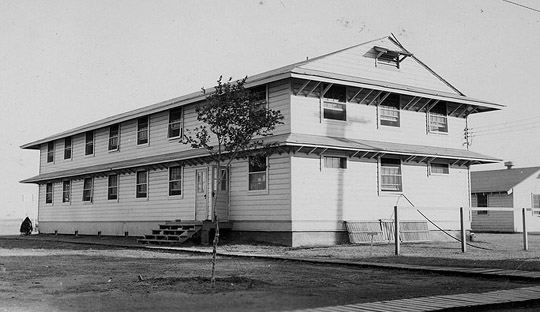
Avon Park Army Air Field was located roughly in the middle of Florida, east of Tampa. It stretched over more than 350 square miles of mostly swamp land in a county with the strange name of Okeechobee. Orange trees grew all over the area and that was quite an exotic sight to a dry corn farmer like me. No one seemed to mind if you helped yourself to an orange now and then either and I enjoyed my share. Like the water towers at Pampa and Enid airfields, the Avon Park field had its memorable building, a band stand. It was actually used for band concerts to entertain us while we were there. There was a lake on the north end of the camp and my first sight of a water moccasin there made me determined not to have to ditch anywhere in Florida.

The base had multiple uses but mostly it was for live bomb training. There were some military there for survival training and some for learning chemical warfare which was a sobering thought when we learned about it. There were also a lot of guys there training in aircraft maintenance. Not too far away as the crow flew, just outside Tampa (about 100 miles west) there was another B-26 training field, McDill Field.

We were being prepared to go overseas to fight the war in Europe and we were sent to Avon Park not only to learn how to fly the two engine B-26 (or the 4-engine B-17s)but to be trained in combat flying, bombing and gunnery skills. In other words, war games. We would be learning how to hit targets, survive, as well as how to do things like navigate by the stars. Florida is not too wide and when you took off it was only a matter of minutes, whether you headed east or west, until you were over either the Atlantic on the east or Tampa Bay on the west. This was pretty intense training with a lot of flying.

There were thousands of people on the base and very little base housing. Many of the guys, mostly officers and their families, lived off base in motels around the area. We were in very basic accommodations on the base.


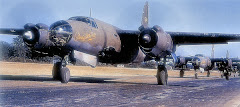
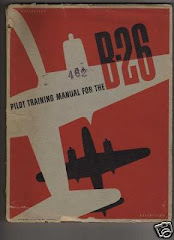
The B-26 was a twin-engine bomber made by Martin. It had very high wings and they were short wings. It had large Pratt-Whitney engines with Curtis electric propellers. Since it had such a high wing loading and only two engines, if one of the engines lost power it was hard to control. The electric props had a tendency to go into flat pitch, which would cause them to over-speed and loose thrust if the power was interrupted. There was a manual override that would put them back into the right pitch again.

The large engines produced a lot of speed for a medium size bomber so take offs and landings were at speeds of 125-130 mph. Lower speeds caused it to stall on landing. I explain this because the planes had a well deserved bad reputation and it took experience and some strength to fly them.

The first week I was in transition our base lost six planes and crews just off the end of the take-off runway. Thus the B-26 had developed several rather depressing nick names. Martin Marauder was the best of them. It was also known as the Widow Maker and The Flying Coffin. There were a couple more I don’t choose to mention. The guys over at McDill were having the same problems we were and had coined the slogan “One A Day in Tampa Bay” to describe the sad situation.

I was lucky because my first flight was with the Squadron Commander and he gave me a very good briefing before we took off. Sure enough, just after take off the right prop went into flat pitch. We got it under control and had a successful flight. This training came in handy later when I was training in Ireland. Many modifications were eventually made to the plane and when all was said and done, the B-26s had the lowest losses of any combat airplane in the war. The B-26 flew over 11,000 sorties during WWII and was one of the greatest planes flown in the war.