Follow The Story from the Beginning

Follow the Story from the Beginning
This story was partly written and partly recorded by The Captain. It's told in Chapters. To read the story in the order it's told, start with the first Chapter by using the Archive list in the right column. When you catch up, you can sign up to get a notice each time a new chapter is posted.

Friday, September 24, 2010

Chapter 20 - We Ditch in the Swamp

When I got back to the Avon Park base, suddenly the tar paper shacks we bunked in were more uncomfortable than they had been before my leave. The quality of the food was hard to swallow and not because of my tonsillectomy. The August heat and humidity were oppressive. A week with family and the promise of a romance were hard to leave behind and had spoiled me a little.

The military has a way of yanking you back to attention. We went right back to calisthenics, marching to the mess hall, maintaining our quarters, attending classes and practicing flying techniques. Mostly that meant takeoffs and landings, which were never really monotonous for the pilots but the crew probably tired of them. There were also days when we did bombing target practice with no ammunition and eventually with live bombs.

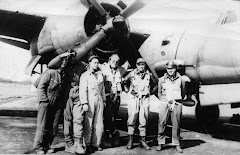
We’d been assigned to flight crews of six. I was the co-pilot. One day when we were practicing take offs and landings we had a close call not too different from my first training flight with the Squadron Commander. Right after we were airborn and the landing gear was retracted, one engine went into flat pitch and quit! This was a 2-engine bomber! It was pretty hard to fly without one engine. We were past the end of the runway and over the swamp. All the power was coming from the other engine and it took everything we had to keep it from flipping over - at the same time we were going down fast. Things were happening very quickly.

Lt. Davidson, the Captain, alerted the tower we had an emergency landing and somehow managed to slide us into the swamp on the plane’s belly without doing much damage. Ambulances and fire trucks arrived. No one was hurt but we had to wade through the swamp to get back to the runway. I kept thinking of those water moccasins I’d seen and couldn’t get out of there fast enough for my comfort. We were lucky there was no live ammunition in the swamp.

The ambulance was waiting and took us back into camp to make sure we weren’t injured. They had to pull the plane out of the swamp, so later that day we got another plane and went on with training maneuvers - more take offs and landings. That was kind of ruff after the heart stopping event earlier. On the plus side, all the repetitive training, drills and memorization that the military drilled into us stood us in good stead in emergencies. You knew what to do.You reacted almost without thinking. I believe that belly whopper went on record as a crash landing even though they recouped the plane. It was another lesson that would pay off in my future. It gave us all something to write home about that night. And I was writing to "my gal" almost every night since I got back. 

Secretly there was something nagging me, a little guy waving a red flag in the back of my mind. He was pestering me. I'd tried my darndest not to be a medic when I joined the Army and had ended up being a medic because I knew how to type (see Chapter 6). It's true, I got lucky and got into the Cadet program but I still had the skills of a medic and knew I would have to use them whenever a crisis required them. Things went smoothly for awhile. Then I saw that water moccasin and swore I would never ditch in the swamp. A few weeks later we ditched in the swamp. Then there was the other incident where the Squadron Commander gave me my first lesson and told me about the tendency of the B-26 to flat pitch on take off. About half an hour later it happened. I was beginning to think that these things all added up to something - what I didn't know. All I knew was that little guy was back there waving those red flags and I was starting to think I'd better pay more attention to him.

Saturday, September 18, 2010

Chapter 19 Surgery Brings Another Leave Before Shipping Out


 Along with learning to the fly the bombers, playing war games and basically getting us into “survival” mode, the Army was getting us physically ready to go overseas into combat. It was 1943 and Europe needed pilots, planes and crews. We were all going through extensive physicals prior to being shipped out. I was having a lot of sore throats and the doctors decided that I had to have my tonsils out before they would send me over. So, they operated and gave me a 10 day leave to recuperate. It was too far to head for home in Nebraska, so the logical place to recover was back to my brothers place near Terre Haute. I checked out and caught the next train going north. I admit I wanted to see how my niece was doing with her new bicycle. Maybe she’d need another lesson from the lady who sold it to them. Again it was nice to be with family and I enjoyed the home cooking.

Luckily for me I didn't have to drop any hints about my interest in the lady with the bike, my sister-in-law was already busy doing a  little matchmaking. She invited Lori, the lady who sold them the bicycle, to dinner a couple days after I got there. I was still having a little trouble swallowing but it didn’t seem to affect my ability to talk. They tell me the table was set with the best tablecloth and saved up ration stamps were used for a roast. I was just thankful there were mashed potatoes and homemade applesauce from the tree in the yard. I was hoping our guest wouldn’t notice I wasn’t eating anything that wouldn’t slide right down my throat. I passed on the apple pie and was glad to have honey and tea instead of coffee, which was hard to get then. (Rationing started in1942 and tires, sugar, coffee, meat and eventually almost everything you couldn't grow had to be purchased with ration coupons. People got two rations books a month. I remember one had red coupons and the other blue. There were lots of rules and regulations, it was a complicated program.)

I thought this lady was pretty special so we spent quite a bit of time together during my leave – at least when my niece would let us. My brother and sister-in-law insisted on teaching us how to play bridge and every night we were getting to know each other while playing cards. Before I left we agreed to correspond.

Wednesday, September 8, 2010

Chapter 18 Avon Park, FL - B-26 Transition - One A Day in Tampa Bay

Avon Park Army Air Field was located roughly in the middle of Florida, east of Tampa. It stretched over more than 350 square miles of mostly swamp land in a county with the strange name of Okeechobee. Orange trees grew all over the area and that was quite an exotic sight to a dry corn farmer like me. No one seemed to mind if you helped yourself to an orange now and then either and I enjoyed my share. Like the water towers at Pampa and Enid airfields, the Avon Park field had its memorable building, a band stand. It was actually used for band concerts to entertain us while we were there. There was a lake on the north end of the camp and my first sight of a water moccasin there made me determined not to have to ditch anywhere in Florida.

The base had multiple uses but mostly it was for live bomb training. There were some military there for survival training and some for learning chemical warfare which was a sobering thought when we learned about it. There were also a lot of guys there training in aircraft maintenance. Not too far away as the crow flew, just outside Tampa (about 100 miles west) there was another B-26 training field, McDill Field.

We were being prepared to go overseas to fight the war in Europe and we were sent to Avon Park not only to learn how to fly the two engine B-26 (or the 4-engine B-17s)but to be trained in combat flying, bombing and gunnery skills. In other words, war games. We would be learning how to hit targets, survive, as well as how to do things like navigate by the stars. Florida is not too wide and when you took off it was only a matter of minutes, whether you headed east or west, until you were over either the Atlantic on the east or Tampa Bay on the west. This was pretty intense training with a lot of flying.

There were thousands of people on the base and very little base housing. Many of the guys, mostly officers and their families, lived off base in motels around the area. We were in very basic accommodations on the base.


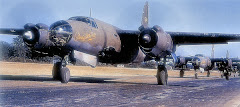
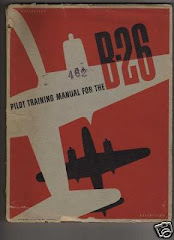
The B-26 was a twin-engine bomber made by Martin. It had very high wings and they were short wings. It had large Pratt-Whitney engines with Curtis electric propellers. Since it had such a high wing loading and only two engines, if one of the engines lost power it was hard to control. The electric props had a tendency to go into flat pitch, which would cause them to over-speed and loose thrust if the power was interrupted. There was a manual override that would put them back into the right pitch again.

The large engines produced a lot of speed for a medium size bomber so take offs and landings were at speeds of 125-130 mph. Lower speeds caused it to stall on landing. I explain this because the planes had a well deserved bad reputation and it took experience and some strength to fly them.

The first week I was in transition our base lost six planes and crews just off the end of the take-off runway. Thus the B-26 had developed several rather depressing nick names. Martin Marauder was the best of them. It was also known as the Widow Maker and The Flying Coffin. There were a couple more I don’t choose to mention. The guys over at McDill were having the same problems we were and had coined the slogan “One A Day in Tampa Bay” to describe the sad situation.

I was lucky because my first flight was with the Squadron Commander and he gave me a very good briefing before we took off. Sure enough, just after take off the right prop went into flat pitch. We got it under control and had a successful flight. This training came in handy later when I was training in Ireland. Many modifications were eventually made to the plane and when all was said and done, the B-26s had the lowest losses of any combat airplane in the war. The B-26 flew over 11,000 sorties during WWII and was one of the greatest planes flown in the war.

Wednesday, September 1, 2010

Chapter 17 -The Train Trip That Changed My Life

After about seven days of leave I caught the train heading east from North Platte to Chicago, the first leg of my journey to Florida. In Chicago, I transferred to a train called the Dixie Flagler that ran most every day down through the Midwest and South to Central Florida. The Flagler was a first class train that was then used mostly for moving troops. There were many soldiers and other military personnel on board, either on their way south for training or on their way overseas. The train had a club car that was open to any rank. It was a rolling party. Most of us couldn’t afford to pay for drinks but we had our own flask. I didn’t run into anyone I recognized, but it seemed like we all knew each other.

Along about dark that first night on the Dixie, I heard the conductor call out that the next stop was Terre Haute, Indiana. I remembered that’s where my older brother and his family lived now. On the spur of the moment, I grabbed my duffle bag and got off the train. I called my brother. He picked me up and took me out to their house where I enjoyed another home cooked meal and being with family. Their daughter, my niece, was all excited about getting a bicycle for her birthday. They’d bought her a used bicycle from a lady in town and the woman was to deliver the bike the next day. Luckily, she got there with the bike early in the day - before they had to take me back to the station late that afternoon.

I was smitten immediately. She was a cute, petite, outgoing gal with a great smile. She was friendly, spirited and had a sense of humor. She fit right in with the family and from then on she and my niece became great friends. We spent most of the day teaching my niece how to ride the bike. Everyone enjoyed Lori’s company so much my sister-in-law invited her to stay for an early picnic dinner before they took me back to catch that night’s train headed for Florida.  It was a short stop but one that changed my life.

Saturday, August 28, 2010

Chapter 16 - We Find Out The Answer To Our Dreams

During all our flight training classes the army had been giving us tests: physical tests, mental tests, psychological tests, emotional tests, intelligence tests. You name it, we took it, most of time more than once. They were also constantly observing us and taking notes for our files. All this helped them decide the answer to the question we’d all been waiting for – would we be bomber pilots or fighter pilots? 

It was every guy’s dream to be a fighter pilot. They were the “glamour guys” of the war, the ones newspaper stories were written about and newsreels (movies) were made about. They flew lighter, faster planes and their mission was to attack the enemy and protect the bombers. They were what you call "Top Guns" today. You might say they had the ability to control destiny - theirs and that of the bomber crews.

Bomber pilots and crews were always in demand. They suffered more casualties than the fighter pilots who protected them from enemy attack while they were flying straight through all the anti-aircraft fire (ack ack). The bombers were not only bigger and heavier planes, they were loaded with tons of ammunition. Their mission was to follow orders - to hit specific targets.

So it's no surprise there were different qualities required for the fighter pilot and the bomber pilot. That's what all those tests had been sorting out. Fighter pilots were independent, bold, aggressive, cocky, fast moving, fast thinking and highly motivated. There was a certain recklessness and exhibitionism that was not only tolerated in a fighter pilot, it was necessary. They were risk takers and loners, they depended on no one but themselves. They flew alone and made their own split second decisions. Their job was to guard and look out for the bombers, anticipate attacks and protect bombers. If the enemy came after a bomber formation the fighters were to engage them before they reached the bombers.

Bomber pilots were picked for physical strength, solid dependable judgment, emotional stability, leadership skills and being able to develop a team that worked like clockwork and trusted each other. They had a crew they were responsible for as well as an airplane.

After we got our wings, we were given a 10 day leave before we had to report in to our next base. I went home to Nebraska with my family, which turned out to be enroute to my assignment to B-26 Transition School in Avon Park, Florida

I was going to be a bomber pilot.

Saturday, July 31, 2010

Chapter 15 Graduation from Advanced Pilot Training May 42

Finally in late May of ’42 it was time to graduate and get those coveted Silver Wings.

The graduation was held in the base theater at ten in the morning. My folks and my oldest sister came down from Nebraska and my oldest brother, the one that I’d worked for on the ranch, and his wife came. My other brother and his family, that ones that I’d lived with when I was working on the cotton inspection team, had been transferred to a small community in southern Illinois where he was managing a pipeline station. The closest large town to them was Terre Haute, Indiana. Later, that had a big part to play in my life.

Our Graduation was as impressive as any ceremony I’ve ever attended since. The pomp and circumstance started and ended with marching of course. It’s hard to explain the thrill of being in uniform and marching in cadence while singing an inspiring song like the Army Air Corp anthem or the National anthem. It made your chest swell up with pride. I couldn’t carry a tune but luckily I was drowned out by a corps that could, and I felt like million as I sang at full volume and strode into the hall. We took an oath to our country and listened to a couple of speeches which congratulated us on surviving the most demanding training course in the military. The Brigadier General told us that so far over 40% of the cadets who entered flight training had washed out before graduating.

Next came the moment we anticipated, the presentation of the Silver Wings by the Lieutenant Colonel R. C. McBride. At the same time, we were promoted to 2nd Lieutenant, received our gold bars and a big dose of pride and excitement. In addition to the wings and the bars we also got a packet of “calling cards” with our name and rank: Lieutenant Air Corps, which we promptly exchanged with the other guys in our class and gave to our families. There was another benefit that we (and our families) appreciated and that was our new pay scale. We were now going to make $1,800 a year, plus we were entitled to a 50% bonus for flight pay!
It was a tradition when you received your Silver Wings that the first person that had to salute you, had to give you a dollar! That was a lot of money in 1942 when a bottle of cola was 5 cents and the daily newspaper cost 3 cents. Usually it was one of the lower classmen. I was so excited I have no memory of who had to give me my dollar.

Sunday, August 9, 2009

Chapter 14 Advanced Flight School - Pampa Texas

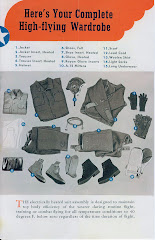
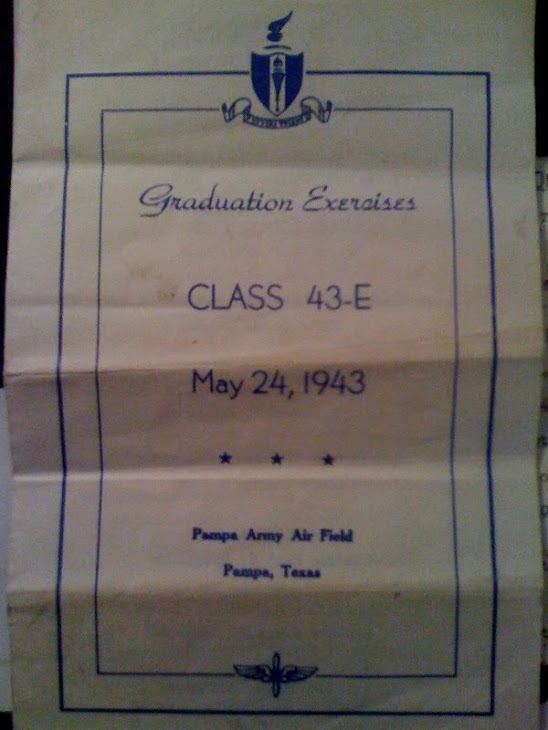
After a week’s leave and a Greyhound bus ride to the panhandle of Texas about 40 miles northeast of Amarillo, where the Pampa Army Airfield was located, we started Advanced Flight School. It was February 1943 and the weather was often cold and sometimes stormy. The skies were generally clear with big cumulus clouds and fierce air currents. We appreciated the special uniforms, boots and gloves to help keep us warm when we were in the air, where it was many degrees colder than the Panhandle.

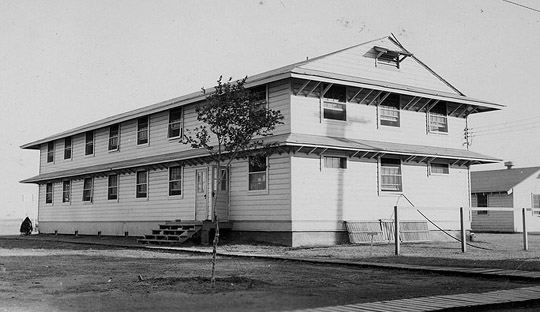
Although the airfield was similar to the one at Enid in terms of runways, hangers, control tower and water tower, the living accommodations were nothing like the nice two story barracks we’d had at Enid. We were now living in what might be termed a tar paper shack. Luckily we were there to learn to fly, and as far as accommodations we were all in the same boat, as always.

Now we were learning how to maneuver twin engine planes. They were faster, more complex, less forgiving and definitely more challenging. We had to learn how to handle the new power and speed. All the courses we’d learned in basic were geared for these bigger, more powerful planes. Meteorology and Navigation were delved into deeper here. And, we finally learned how to shoot those guns we’d been marching with. There was a skeet shooting range on the base and some of the guys had to spend a lot more time there than I did because of my pheasant hunting days. We were still doing calisthenics, obstacle courses and weightlifting. I had always been strong from my farming days but I was now feeling like quite the athlete.

We had about 12 hours of flying with the instructor before we did our daytime solo and around 25 for our nighttime solo. We practiced takeoffs and landings over and over, probably doing 80 or 90 during our training, most of them at night. Most flying was now done by instruments. There were six students per instructor in our class. Our instructor got our group checked out in an AT-9. Most of the instructors thought the AT-9s were too hot for students and kept them flying the AT-17s but we loved the 9s and had a ball with them. This is when we learned to love to fly.